Introduction
Most facility managers know where their buildings are located.
Far fewer know exactly where their underground infrastructure is located.
Water lines, sanitary sewer systems, storm drainage, electrical feeders, communication lines, irrigation systems, and other underground assets often represent some of the most valuable components of a facility. Yet, in many cases, the documentation available for these systems is incomplete, outdated, or simply unavailable.
As facilities evolve through renovations, repairs, expansions, and emergency work, underground infrastructure records frequently become less accurate over time.
This is where Utility Infrastructure Mapping becomes an essential management tool.
Accurate utility infrastructure mapping provides facility owners and managers with reliable information that supports maintenance planning, future construction projects, emergency response, and long-term asset management.
- Introduction
- What Is Utility Infrastructure Mapping?
- Why Utility Records Become Inaccurate Over Time
- The Hidden Cost of Missing Underground Utility Information
- How Utility Infrastructure Mapping Supports Facility Management
- Utility Mapping and Future Capital Improvement Projects
- Utility Infrastructure Mapping vs. Utility Locating
- When Should a Facility Update Its Utility Records?
- Final Thoughts
- Need Reliable Utility Infrastructure Information?
What Is Utility Infrastructure Mapping?
Utility Infrastructure Mapping is the process of identifying, documenting, and creating a comprehensive record of underground utility systems within a facility or property.
The process may include:
- Water distribution systems
- Sanitary sewer systems
- Storm drainage systems
- Electrical distribution systems
- Communication and data networks
- Irrigation systems
- Private utility infrastructure
- Abandoned utility systems
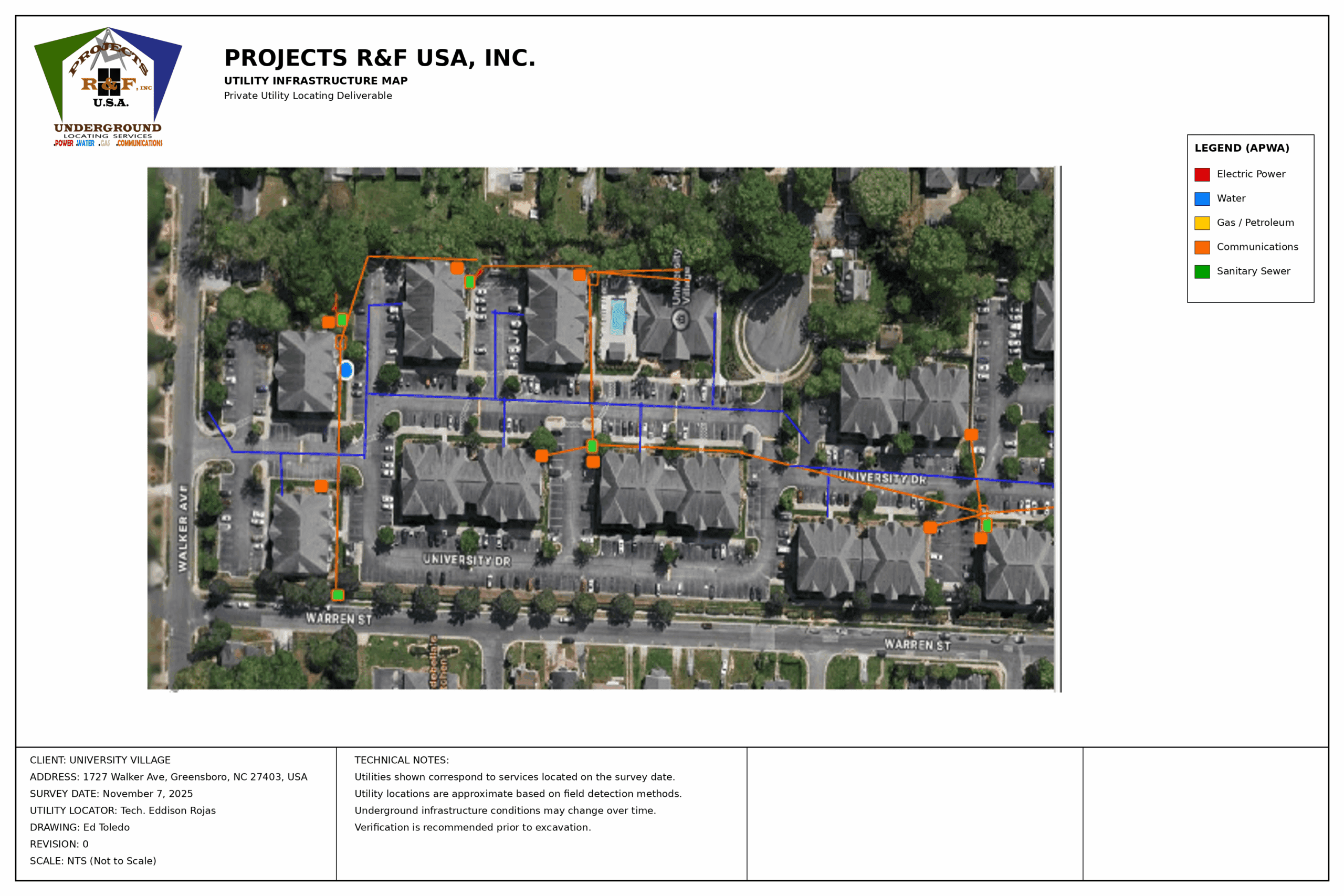
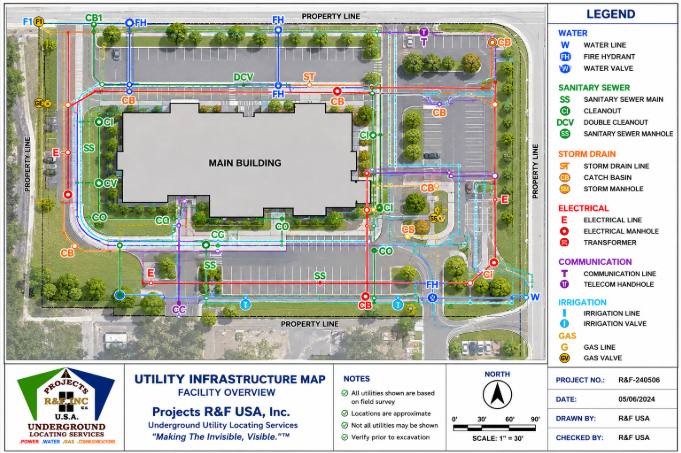
Using technologies such as electromagnetic locating, Ground Penetrating Radar (GPR), GPS positioning, CAD drafting, and GIS integration, utility infrastructure mapping transforms underground utility information into usable facility records.
Many utility mapping and subsurface utility engineering practices are guided by industry standards such as the ASCE 38-22 Standard for Utility Investigation and Documentation.
ASCE 38-22 Standard for Utility Investigation and Documentation
The result is a visual representation of critical underground assets that can be used for planning, maintenance, and decision-making.
Why Utility Records Become Inaccurate Over Time
Many facilities begin with accurate construction drawings.
However, underground infrastructure rarely remains unchanged throughout the life of a facility.
Over time, changes occur such as:
- Emergency repairs
- Utility relocations
- Facility expansions
- New building construction
- Utility replacements
- Contractor modifications
- Abandoned utility systems
Unfortunately, these modifications are not always documented properly.
As a result, facility records that were accurate years ago may no longer reflect current field conditions.
This gap between existing documentation and actual underground conditions often creates uncertainty when planning future projects
The Hidden Cost of Missing Underground Utility Information
Many organizations do not realize the true cost associated with incomplete underground utility information.
The consequences may include:
Project Delays
Unexpected utility conflicts frequently stop construction activities while crews investigate underground conditions.
Increased Project Costs
Additional excavation, redesign, utility relocation, and change orders can significantly increase project expenses.
Safety Risks
Unknown electrical lines, communication systems, water mains, and other buried infrastructure can create hazardous conditions during excavation activities.
Industry organizations such as the Common Ground Alliance continue to emphasize the importance of accurate underground utility information to help reduce excavation-related incidents.
Common Ground Alliance (CGA) Best Practices
Emergency Response Challenges
During emergencies, facility personnel need immediate access to accurate infrastructure information.
Without reliable records, response times can increase and critical decisions become more difficult.
Loss of Institutional Knowledge
Facilities often depend on employee experience to understand underground infrastructure.
When key personnel retire or leave the organization, valuable knowledge can disappear with them.
How Utility Infrastructure Mapping Supports Facility Management
Facility managers are responsible for maintaining operational continuity while controlling costs and minimizing risk.
Utility Infrastructure Mapping directly supports these objectives:
Improved Maintenance Planning
Knowing the location of underground assets helps maintenance teams perform repairs more efficiently and with greater confidence.
Better Capital Improvement Planning
Infrastructure mapping provides reliable information for future construction and renovation projects.
Reduced Excavation Risk
Project teams can make informed decisions before excavation begins.
Improved Contractor Coordination
Contractors can better understand site conditions before starting work.
Stronger Asset Management
Infrastructure records become part of the facility’s long-term asset management strategy.
Utility Mapping and Future Capital Improvement Projects
One of the most valuable benefits of Utility Infrastructure Mapping is its ability to support future capital improvement projects.
Before designing or constructing new infrastructure, project teams need accurate information regarding existing underground conditions.
Without this information, projects often rely on assumptions.
Those assumptions can lead to:
- Design conflicts
- Unexpected utility relocations
- Construction delays
- Increased project costs
Facilities that maintain current utility mapping records are generally better prepared to execute future capital projects efficiently.
Utility Infrastructure Mapping vs. Utility Locating
Although these services are related, they serve different purposes.
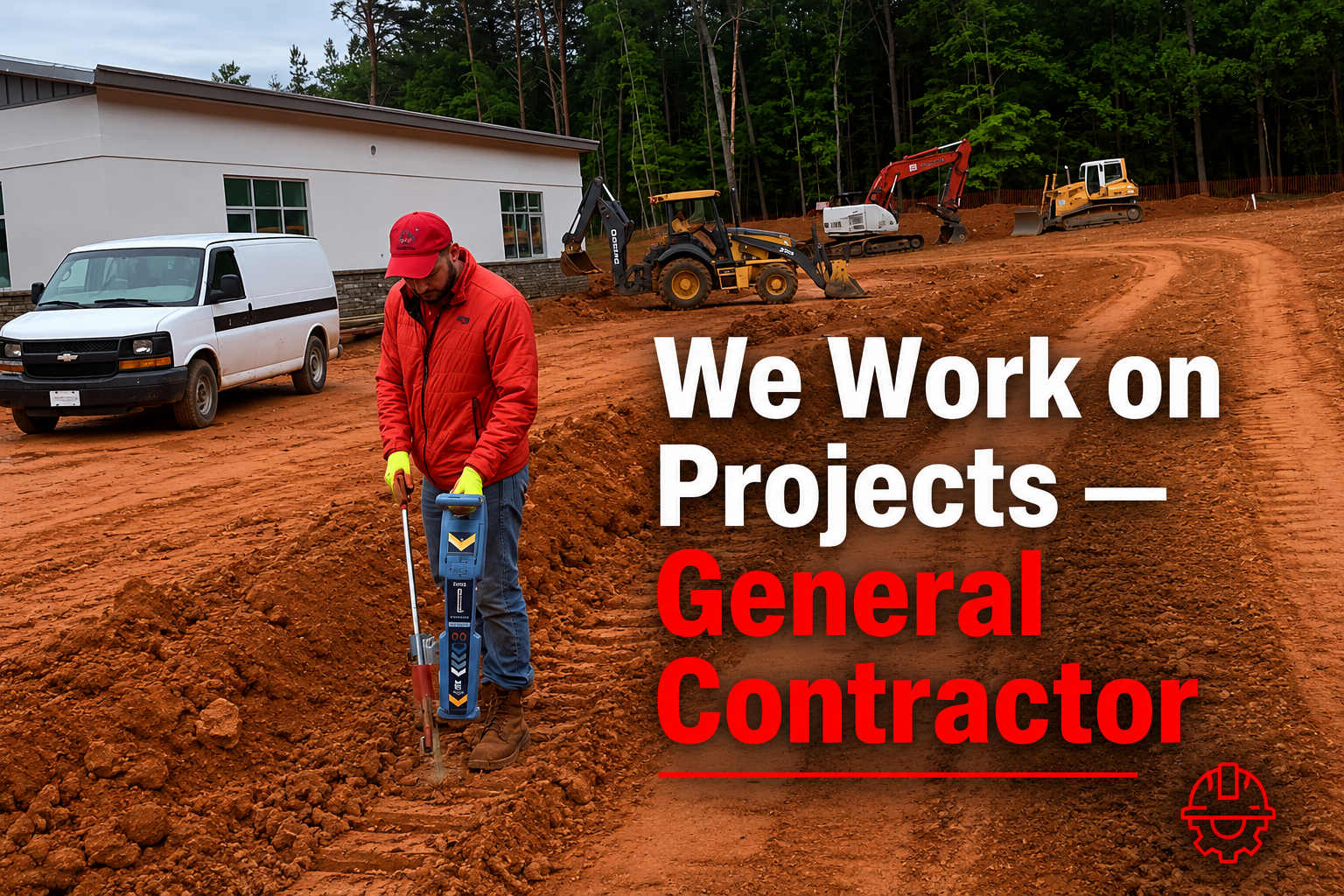
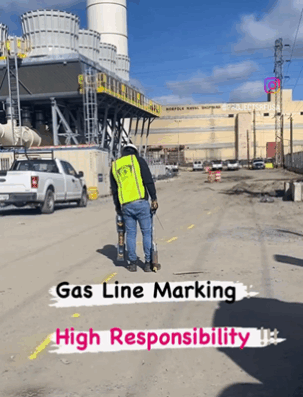
Utility locating is typically performed to identify underground utilities within a specific work area before excavation or construction activities.
The objective is to reduce risk during a particular project.
Utility Infrastructure Mapping
Utility Infrastructure Mapping creates a permanent record of underground assets across a facility or property.
The objective is long-term infrastructure management.
In simple terms:
Utility Locating helps support a project.
Utility Infrastructure Mapping helps support the entire facility.
Many organizations benefit from using both services as part of a comprehensive infrastructure management strategy.
When Should a Facility Update Its Utility Records?
There is no single answer that applies to every organization.
However, utility infrastructure mapping should be strongly considered when:
- Facility expansions are planned.
- Major renovations are anticipated.
- Existing records are outdated.
- Underground utility information is incomplete.
- New infrastructure has recently been installed.
- Emergency response planning is being improved.
- Capital improvement programs are being developed.
The sooner utility information is documented and maintained, the greater the long-term value to the organization.
Final Thoughts
Can a facility effectively manage infrastructure that it cannot accurately identify?
For many organizations, the answer becomes increasingly difficult as infrastructure grows and evolves.
Utility Infrastructure Mapping provides facility owners and managers with a clearer understanding of the assets hidden beneath their property.
By maintaining accurate underground utility records, organizations can improve planning, reduce uncertainty, support future projects, and make better infrastructure decisions.
The most successful facilities are not simply maintaining their infrastructure.
They are managing it strategically.

Need Reliable Utility Infrastructure Information?
Projects R&F USA, Inc. provides Utility Infrastructure Mapping, Private Utility Locating, Ground Penetrating Radar (GPR), and underground utility investigation services to support facility managers, contractors, engineers, and property owners throughout North Carolina, South Carolina, and Virginia. – For many organizations, Utility Infrastructure Mapping is no longer a luxury—it is becoming an essential part of responsible facility management.
Make The Invisible, Visible.
Are You 100% Sure Your Project Is Safe Before Digging?